One of the most critical stages in the design of complex geometric facades is design optimization. At GENx, we see this process not simply as simplifying a form, but as intelligently aligning design with production, bridging computational precision with real-world manufacturing logic.
Our background in computational design allows us to analyze and rationalize complex geometries through data-driven modeling, parametric control, and algorithmic evaluation. This approach helps us anticipate fabrication constraints long before they appear on site. At the same time, our close communication with manufacturers ensures that these digital models are grounded in reality; every optimization we make is validated by material behavior, production tolerances, and assembly methods defined by the manufacturer.
For us, design optimization is not just about shaping form, but about creating a fluent dialogue between the digital model and the manufacturing perspective, where design intent and production capability truly meet.

From Architectural Geometry to Production Reality
When we first become involved in a project, we begin by examining the geometry from a production perspective. Architectural facade drawings may be prepared without fully considering manufacturing constraints, and in complex forms this often leads to significant coordination challenges.
Our first step is to clean the geometry, such as defining work points, identifying center points of curved forms, setting radii to whole numbers, and optimizing the spacing between elements. This allows us to create a single geometry plan that maintains architectural integrity while being ready for production. That plan then becomes the shared reference for all stakeholders throughout the project.
Early Integration: The Key to True Optimization
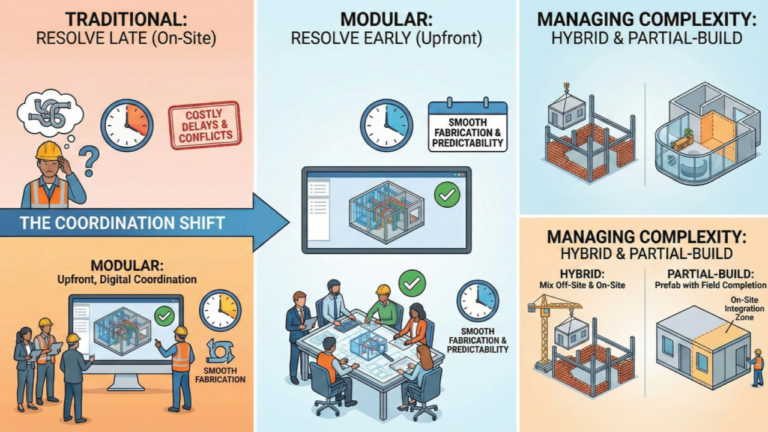
Early coordination with the manufacturer is essential. When manufacturers join the process too late, it becomes much harder to adjust design decisions. By involving them from the beginning, we gain clear advantages:
- Material limits are defined early.
- Tolerances are embedded into the design.
- Potential cost-saving opportunities are visible from the outset.
In this way, optimization becomes not only geometric but operational. For instance, in some cases, a glass facade defined as an arc in the architectural model may be produced as a series of flat segments if this approach offers clear advantages in fabrication, installation, or cost efficiency.
Before making such adjustments, we carefully evaluate the options together with the manufacturer, the design team, and the engineers. The goal is to preserve the original design intent while ensuring that the solution remains technically and economically feasible. If a proposed change compromises the architectural character or design vision, the geometry is maintained as originally conceived, and other optimization strategies are explored instead.

Experience Over Software
For us, design optimization is not a software output but a reflex shaped by experience. In every project, we bring together manufacturing insight, engineering precision, and design intent together at the same table.
The result is not just an efficient facade but a system that carries the entire process:
- Clean Geometry
- Accurate Data
- Fast Production
- Risk-free Installation
A Clear Design Philosophy
Many of today’s complex-looking facades are in fact the product of a clear and rational way of thinking. For us, design optimization isn’t about simplifying the form; it’s about clarifying it with the right information. And at the core of this approach lies one principle: integrating real production data into design.
Interested in our practice? Let’s connect and discuss your project!
Contact us: genx@genxdt.com; 1(201)-500-7534