Integrated Project Delivery (IPD) is a project delivery method designed to align key participants early around shared goals, transparent information flow, and outcomes-based incentives. The idea has been evolving for decades, accelerated by Lean thinking and digital coordination tools, but it is gaining momentum now for a simple reason: many projects have become too complex and too time-sensitive for fragmented delivery to reliably perform.
What is driving the renewed interest in IPD?
- Owners are prioritizing predictability, operational readiness, and lifecycle value, not only lowest first cost
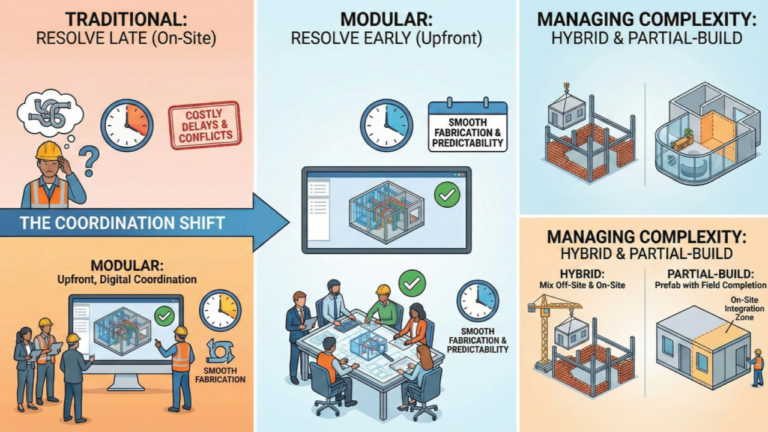
- Technical complexity is increasing, so late coordination failures translate directly into schedule risk and rework
Teams have better tools and practices (BIM/VDC, pull planning, Target Value Design) that work best when the commercial model supports early integration
How IPD works: roles, flow, and decision-making
- Early integrated team: Owner, designer, builder, and often key trades align early to resolve cost, schedule, constructability, and performance priorities sooner.
- Shared commercial model: Often built on a multi-party agreement with open-book transparency and incentives tied to overall project outcomes.
- Joint governance: Shared decision-making is supported by clear escalation paths, a standing leadership forum, and transparent decision records so the team can make timely “best-for-project” calls.
- Disciplined planning routines: Lean-style coordination (Pull planning, weekly work planning, and constraint removal) and commitment management help translate collaboration into predictable delivery.

GENx is embedded within the IPD core team and supports coordination across all disciplines
Why teams pursue IPD: the advantages in one view
When IPD works well, the benefits tend to show up in very specific places that matter to professional readers.
- Earlier problem discovery through early trade involvement and structured collaboration
- More reliable commitments because planning and constraints are addressed with the full team, not sequentially
- Fewer downstream conflicts since incentives are designed to reduce finger-pointing and encourage joint resolution
- Stronger quality and smoother closeout driven by better coordination and fewer late-stage surprises
- Better alignment to owner outcomes like operational readiness, commissioning goals, and performance targets

Through end-to-end digital delivery, GENx coordinates stakeholders across design and construction, reducing handoffs and accelerating the overall IPD process
Why adoption is uneven: barriers, risks, and the profitability question
Despite strong interest, IPD remains unevenly adopted. Research synthesizing practitioner perspectives points to three recurring obstacles: initial high cost, contractual hardships, and implementation complexity.
The AIA guide adds an important operational reality: MPAs (Multi-Party Agreements) require thorough planning, careful negotiation, and intensive team-building early, which can be costly especially for teams without prior experience.
Common adoption barriers:
- Procurement constraints: many public and institutional environments struggle to select teams early and contract across parties in a way that supports true integration
- Contracting and insurance complexity: multi-party structures require more legal alignment, more upfront effort, and sometimes unfamiliar risk allocation
- Capability and culture gap: IPD demands mature planning, cost transparency, and collaborative leadership. Without these, teams carry the overhead but do not capture the value
Shared responsibility challenges:
- Slower decisions if governance is unclear: shared decision-making works best with defined decision rights, escalation paths, and meeting discipline
- Accountability anxiety: teams may worry that “shared outcomes” will dilute responsibility, even though professional accountability still exists
- Trust and transparency are fragile: open-book models can improve alignment, but only if information is used to solve problems rather than to negotiate tactically
That said, making “shared outcomes” real still requires day-to-day structure: clear decision logs, reliable information flow, and disciplined follow-through across design and construction. This is where GenX typically supports IPD teams as an extension of the owner and project leadership, providing project coordination, constructability review, design assist support, and digital delivery management so the right inputs show up at the right time. Combined with pragmatic project management routines, this helps teams reduce ambiguity, accelerate alignment, and keep shared responsibility workable from early design through closeout.
Appendix: Key Term Definitions
- Lean Construction A set of planning and coordination practices focused on organizing work reliably and reducing waste in design and construction.
- Pull Planning A collaborative planning method where the team plans work backward from a milestone to define required tasks and handoffs.
- Target Value Design (TVD) A design approach where cost, scope, and performance targets are established early and used to guide design decisions.
- Entitlements (in IPD) Zoning, permitting, regulatory approvals, and authority sign-offs that must be coordinated with design and construction.
Interested in our IPD practice? Let’s connect and discuss your project!
Contact us: genx@genxdt.com; 1(201)-500-7534