Construction Trends

From Coordination to Collaboration: A Practical Look at Integrated Project Delivery

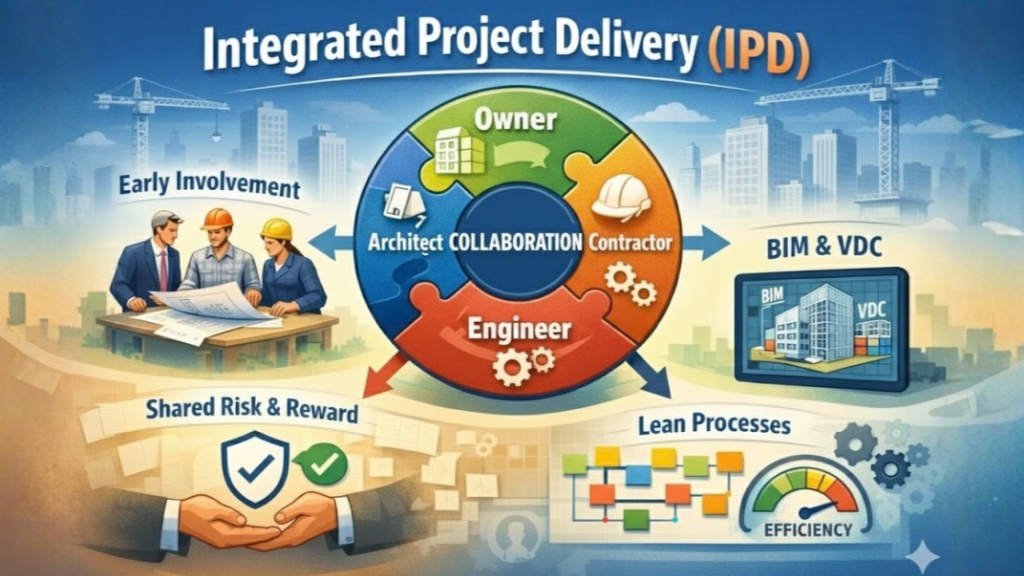
Integrated Project Delivery (IPD) is a project delivery method designed to align key participants early around shared goals, transparent information flow, and outcomes-based incentives. The idea has been evolving for decades, accelerated by Lean thinking and digital coordination tools, but it is gaining momentum now for a simple reason: many projects have become too complex and too time-sensitive for fragmented delivery to reliably perform. What is driving the renewed interest in IPD? Owners are prioritizing predictability, operational readiness, and lifecycle value, not only lowest first cost Technical complexity is increasing, so late coordination failures translate directly into schedule risk and rework Teams have better tools and practices (BIM/VDC, pull planning, Target Value Design) that work best when the commercial model supports early integration How IPD works: roles, flow, and decision-making Early integrated team: Owner, designer, builder, and often key trades align early to resolve cost, schedule, constructability, and performance priorities sooner. Shared commercial model: Often built on a multi-party agreement with open-book transparency and incentives tied to overall project outcomes. Joint governance: Shared decision-making is supported by clear escalation paths, a standing leadership forum, and transparent decision records so the team can make timely “best-for-project” calls. Disciplined planning routines: Lean-style coordination (Pull planning, weekly work planning, and constraint removal) and commitment management help translate collaboration into predictable delivery. GENx is embedded within the IPD core team and supports coordination across all disciplines Why teams pursue IPD: the advantages in one view When IPD works well, the benefits tend to show up in very specific places that matter to professional readers. Earlier problem discovery through early trade involvement and structured collaboration More reliable commitments because planning and constraints are addressed with the full team, not sequentially Fewer downstream conflicts since incentives are designed to reduce finger-pointing and encourage joint resolution Stronger quality and smoother closeout driven by better coordination and fewer late-stage surprises Better alignment to owner outcomes like operational readiness, commissioning goals, and performance targets Through end-to-end digital delivery, GENx coordinates stakeholders across design and construction, reducing handoffs and accelerating the overall IPD process Why adoption is uneven: barriers, risks, and the profitability question Despite strong interest, IPD remains unevenly adopted. Research synthesizing practitioner perspectives points to three recurring obstacles: initial high cost, contractual hardships, and implementation complexity. The AIA guide adds an important operational reality: MPAs (Multi-Party Agreements) require thorough planning, careful negotiation, and intensive team-building early, which can be costly especially for teams without prior experience. Common adoption barriers: Procurement constraints: many public and institutional environments struggle to select teams early and contract across parties in a way that supports true integration Contracting and insurance complexity: multi-party structures require more legal alignment, more upfront effort, and sometimes unfamiliar risk allocation Capability and culture gap: IPD demands mature planning, cost transparency, and collaborative leadership. Without these, teams carry the overhead but do not capture the value Shared responsibility challenges: Slower decisions if governance is unclear: shared decision-making works best with defined decision rights, escalation paths, and meeting discipline Accountability anxiety: teams may worry that “shared outcomes” will dilute responsibility, even though professional accountability still exists Trust and transparency are fragile: open-book models can improve alignment, but only if information is used to solve problems rather than to negotiate tactically That said, making “shared outcomes” real still requires day-to-day structure: clear decision logs, reliable information flow, and disciplined follow-through across design and construction. This is where GenX typically supports IPD teams as an extension of the owner and project leadership, providing project coordination, constructability review, design assist support, and digital delivery management so the right inputs show up at the right time. Combined with pragmatic project management routines, this helps teams reduce ambiguity, accelerate alignment, and keep shared responsibility workable from early design through closeout. Appendix: Key Term Definitions Lean Construction A set of planning and coordination practices focused on organizing work reliably and reducing waste in design and construction. Pull Planning A collaborative planning method where the team plans work backward from a milestone to define required tasks and handoffs. Target Value Design (TVD) A design approach where cost, scope, and performance targets are established early and used to guide design decisions. Entitlements (in IPD) Zoning, permitting, regulatory approvals, and authority sign-offs that must be coordinated with design and construction. Interested in our IPD practice? Let’s connect and discuss your project! Contact us: genx@genxdt.com; 1(201)-500-7534

From Coordination to Collaboration: A Practical Look at Integrated Project Delivery Read More »

Taylorism: A Timeless Framework for Modern Design and Construction

By Ilkay Can-StandardFounder/CEO, GENx Design and Technology As the Founder and CEO of GENx Design and Technology, I’ve spent over two decades navigating the intersection of architecture, construction , manufacturing technology, and innovation. Throughout my career, I’ve witnessed firsthand the challenges that plague project stages, delays, inefficiencies, and miscommunication. Ultimately I get super satisfaction and happiness from efficiency . These recurring issues inspired me to explore solutions beyond traditional methods, leading me to the DFMA which apparently built upon the principles of Taylorism, or Scientific Management.   What is Taylorism? Taylorism, pioneered by Frederick Winslow Taylor in the early 20th century, is a management theory that applies scientific methods to optimize workflows, improve economic efficiency, and enhance labor productivity. At its core, Taylorism is about breaking down complex processes into smaller, manageable tasks, analyzing each step, and eliminating inefficiencies. While it was originally developed for manufacturing, its principles are remarkably adaptable to modern design and construction.   Taylorism in Design and Construction Here’s how we’ve applied its principles to revolutionize the building industry: Process Optimization Taylorism emphasizes the importance of standardizing and optimizing workflows. In construction, this translates to modular and prefabrication strategies. By breaking down projects into standardized components, we reduce waste, minimize errors, and accelerate timelines. This approach has been particularly transformative in our work on high-rise buildings and urban infrastructure. Data-Driven Decision Making Taylor’s scientific approach relies on data to drive efficiency. We leverage cutting-edge tools inspired by aerospace and manufacturing to collect and analyze data throughout the project lifecycle. From BIM (Building Information Modeling) to AI-powered analytics, these tools enable us to make informed decisions, predict challenges, and optimize resources. Collaboration and Specialization Taylorism advocates for assigning tasks based on expertise. We’ve built diverse teams of specialists’ architects, engineers, technologists, and project managers who collaborate seamlessly to deliver solutions. By empowering each team member to focus on their strengths, we ensure both efficiency and creativity. Gathering correct experiences with choreography. Continuous Improvement One of Taylorism’s most enduring principles is the commitment to continuous improvement. We’ve adopted an agile methodology that encourages iteration, testing, and refinement. Whether it’s a design prototype or a construction process, we’re constantly seeking ways to improve and innovate. If we are not innovating, we are improving in a measurable ways. The Future of Taylorism: DfMA and Beyond One of the most exciting applications of Taylorism today is in Design for Manufacturing and Assembly (DfMA), particularly in modular construction. Imagine a future where buildings are assembled like precision-engineered machines efficient, sustainable, and cost-effective.  Imagine the buildings represent their unique contextual characteristics and still be manufactured, with unique styles and healthy materials. This is the future we’re building at GENx. But our vision extends beyond construction. We’re exploring how Taylorism can transform product design, software development, and even user experience. By combining its focus on efficiency with modern technology, we’re paving the way for a new era of innovation Challenges and Ethical Considerations While Taylorism offers numerous benefits, it’s not without its challenges. Critics argue that an overemphasis on efficiency can lead to worker burnout and stifle creativity. We address this by balancing efficiency with empathy. We prioritize the well-being of our teams and foster a culture of collaboration and innovation. After all, true progress is achieved not just through efficiency, but through the collective efforts of passionate, empowered individuals. A Personal Commitment to Innovation As the Chair of the CTBUH New York Chapter and an adjunct professor at NYU, I’m deeply committed to advancing the fields of design and construction. My pride lies in contributing to academia, nurturing the next generation of innovators, and actively engaging in industry feedback and research.   Conclusion Taylorism may have originated over a century ago, but its principles remain deeply relevant in today’s design and construction landscape. At GENx Design and Technology, we’ve embraced its focus on optimization, data, and collaboration to deliver innovative solutions that meet the demands of a rapidly evolving world. As we look to the future, I’m excited to see how Taylorism will continue to shape our industry whether through DfMA, AI-driven workflows, or other groundbreaking innovations. After all, at its heart, Taylorism is about striving for excellence, and that’s a goal we can all get behind. Taylorism: A Timeless Framework for Modern Design and Construction BySystems GENX February 25, 2025 Construction Trends,Management Theories,Taylorism By Ilkay Can-StandardFounder/CEO, GENx Design and Technology As the Founder and CEO of GENx Design… Read More What is the difference between a manufactured home and a modular home? ByIlkay Standard May 15, 2024 Building Information Modeling (BIM) View All Blogs What is the Difference Between a Manufactured Home and a Modular Home? What is the… Read More What are the Advantages of using Modular Construction? ByIlkay Standard March 21, 2024 Building Information Modeling (BIM) View All Blogs What are the Advantages of using Modular Construction? Introduction:In the realm of… Read More Digitalization In The Construction Sector ByIlkay Standard February 27, 2024 Virtual Design & Contruction View All Blogs Digitalization in the Construction Sector: Paving the Path to Innovation Ilkay C… Read More What Is a Facade on A Commercial Building? ByIlkay Standard December 8, 2023 DFMA View All Blogs The Facade of a Commercial Building: Types, Benefits, and Innovations The Facade of a… Read More What is the Difference Between Mass Timber and CLT? ByIlkay Standard December 8, 2023 DFMA View All Blogs Mass timber construction , including cross-laminated timber (CLT), is revolutionizing… Read More What is the difference between BIM and VDC? ByIlkay Standard December 8, 2023 Building Information Modeling (BIM) View All Blogs The Transformative Power of BIM and VDC in Construction The Transformative Power of… Read More How is BIM Connected with Blockchain? ByIlkay Standard December 8, 2023 Building Information Modeling (BIM) View All Blogs What is BIM? Building Information Modeling (BIM) is a digital representation of a… Read More What is Facade in Architecture? ByIlkay Standard December 8, 2023 DFMA View All Blogs Understanding Architectural Facades “Facade” in Architecture: An Overview… Read More

Taylorism: A Timeless Framework for Modern Design and Construction Read More »

Scroll to Top