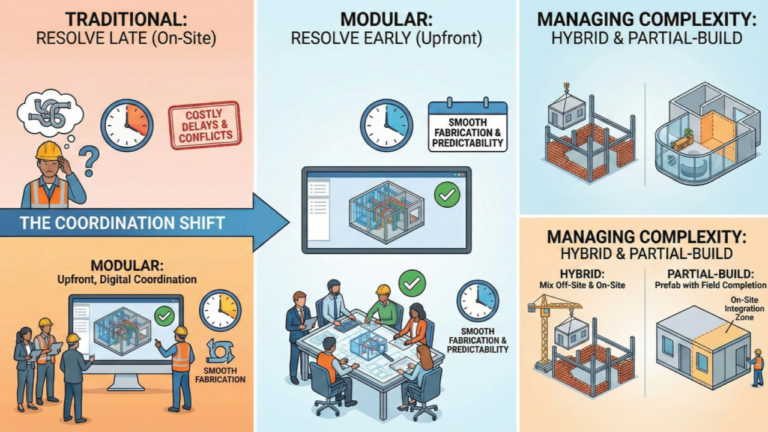
While shop drawings define the geometry of modular buildings, their true impact lies in how they support coordination, BIM processes, and DfMA-driven production strategies. High-quality shop drawings are not just a representation of design; they serve as a vital operational tool that connects disciplines, aligns production workflows, and ensures modules fit together smoothly during installation.
Managing Interdisciplinary Coordination Through Drawings
In modular projects, every module interacts with multiple systems: structure, MEP services, finishes, logistics constraints, and on-site assembly requirements. These interactions must be validated through drawings. To maintain clarity across all disciplines, shop drawings must follow consistent standards for:
- notation
- call-out structure
- information hierarchy
- interface zones
Conflicts during fabrication often arise not from incorrect geometry but from unclear or missing coordination notes. A standardized drawing language significantly reduces misinterpretation and supports predictable module-to-module relationships.

Reflecting the DfMA Approach in Drawings
Design for Manufacturing and Assembly (DfMA) places production and assembly constraints at the center of design decisions. In modular construction, this requires:
- clearly defined tolerances
- connection details that reflect factory tooling and jig requirements
- clarity in lifting, transport, and installation sequences
- early identification of production-critical elements
High-quality shop drawings ensure that these decisions are accurately communicated to the production line.
BIM – Drawing – Fabrication Consistency
A well-managed BIM process is essential. The model should contain all required data for both coordination-oriented shop drawings and high-precision fabrication drawings. Although generated from the same source, each set serves a different purpose:
- Shop drawings → communication, coordination, clarity
- Fabrication drawings → precision, manufacturability, sequencing
Defining the level of detail and data requirements at an early stage ensures consistent coordination between the BIM model, drawing output, and fabrication workflows. This helps to prevent discrepancies such as mismatched dimensions, missing connections, or unclear tolerances.
Revision Management and Information Control
Revisions pose an increased risk in modular construction. Fabrication may already be underway, and even minor updates can affect multiple modules. Effective revision management requires:
- clear and visible revision clouds
- explicit change descriptions
- module-based tracking
- controlled sheet distribution
This prevents outdated information from reaching production and maintains alignment between teams.
In modular construction, high-quality shop drawings play a vital role in more than just documenting the design. They facilitate coordination, support DfMA decision-making, and ensure consistency in the BIM-to-fabrication pipeline. When drawing standards, data structures, and revision controls are aligned, modular projects achieve the precision, efficiency, and predictability that define successful manufacturing-driven construction.
Interested in our practice? Let’s connect and share us more about your project!
Contact us: genx@genxdt.com; 1(201)-500-7534