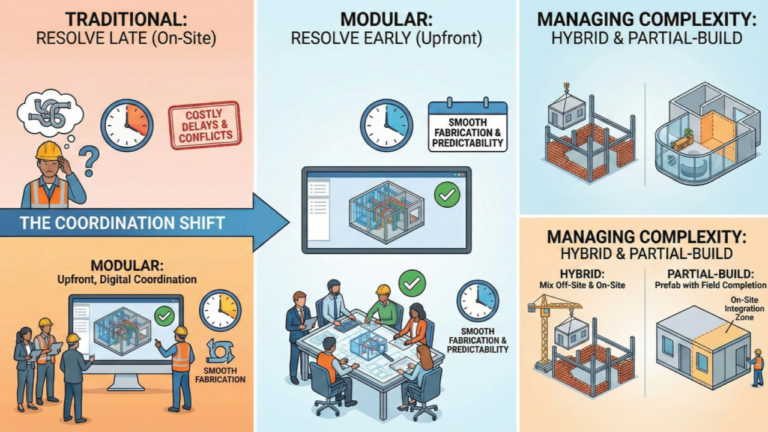
In modular construction, shop drawings act as the central information backbone of the entire project. Unlike traditional construction, where many issues can be resolved during installation, modular systems rely on factory-level precision. Every line, note, and dimension in a drawing directly influences how a module is fabricated and how it fits within the overall structure. This makes shop drawings a foundational communication tool across all disciplines.

Why Accuracy Matters More in Modular Projects
Modular fabrication occurs in controlled production environments where tolerances are tight and workflows depend on upfront clarity. Because modules leave the factory largely complete, late-stage corrections are far more disruptive than in conventional projects. This is why production teams depend on well-organized and unambiguous shop drawings to prevent delays, rework, and misalignment.
Correct Information – Correct Scale – Correct Drawing
Drawing organization requires early planning. Each drawing must be intentional:
- Which scale communicates the required detail?
- Which elements should be included, or omitted, to avoid information overload?
- How will the complete set maintain consistency across hundreds of modules?
Over-detailing can slow fabrication, while under-detailing can cause costly errors. Clear drawing standards established at the start of the project ensure all stakeholders interpret data consistently.
Module Identification and Module Type Diagrams
Among all drawing types, module identification drawings are essential. They define each module’s:
- number
- name
- type
- position within the building
Even if modules look identical architecturally, they may differ in structure, MEP routing, or production sequencing. If these distinctions are not clarified early, the production phase becomes vulnerable to misfabrication.
Typical and Non-Typical Modules
A proven strategy is separating modules into typical and non-typical categories. Typical modules can be documented once with detailed enlarged drawings, while non-typical modules require their own dedicated sheets. This approach streamlines coordination, accelerates reviews, and helps production teams focus on the modules that need special attention.
In modular projects, shop drawings are more than technical documents: they are the operational language that links design intent with manufacturable detail. When drawing organization, clarity, and module identity are managed effectively, production runs smoothly, installation is predictable, and project outcomes become measurable and consistent.
Interested in our practice? Let’s connect and share us more about your project!
Contact us: genx@genxdt.com; 1(201)-500-7534