Building Information Modeling (BIM)

Managing Non-Typical Conditions in Modular Construction

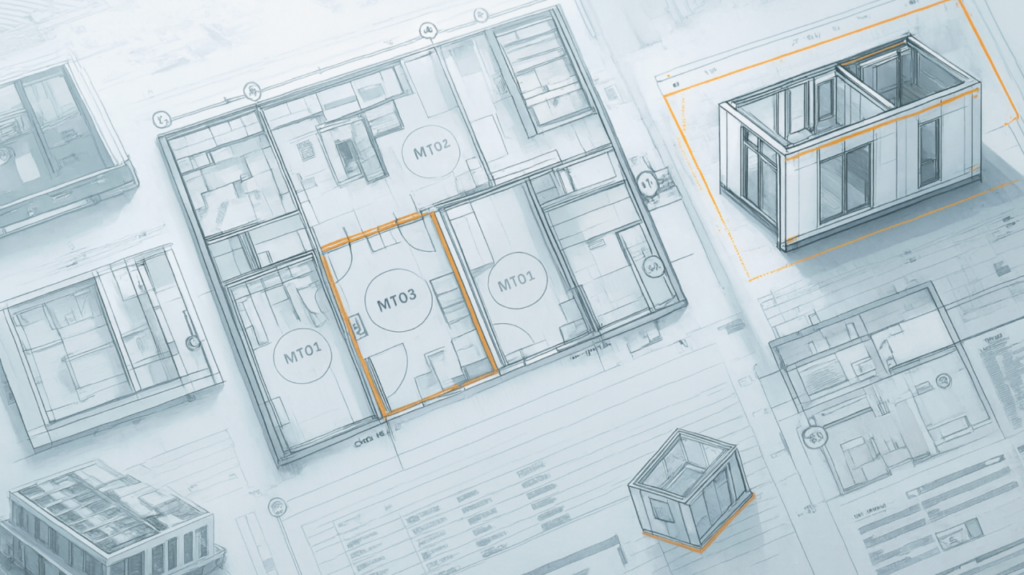
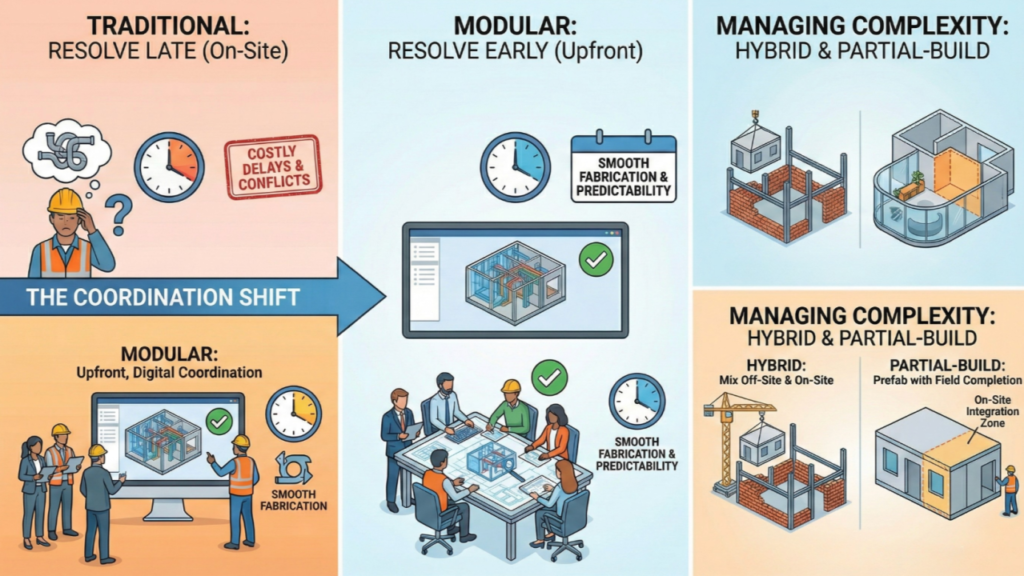
In modular projects, typical conditions are the backbone of efficiency. Repetition enables streamlined fabrication, predictable workflows, and faster production cycles. However, for every advantage gained through standardization, non-typical modules introduce a proportional increase in coordination complexity. These units, often unique in geometry, function, or systems, require a level of upfront design alignment that far exceeds what would normally be addressed on site in a conventional project. Why Coordination Must Happen Earlier In traditional construction, many coordination issues can be resolved directly in the field. A routing conflict or a shaft adjustment can often be handled with relative ease during installation. But in modular construction, prefabrication shifts the problem-solving timeline forward. What could be resolved in hours on site becomes a critical design task that must be finalized before materials are procured and assemblies begin. Once a module enters production, the flexibility to modify becomes limited and costly. The Nature of Non-Typical Spaces Non-typical areas are where complexity becomes most visible. Back-of-house zones, technical rooms, and unique common spaces such as laundry rooms, specialty kitchens, amenity area rarely follow a repeating layout. They often contain dense, non-standard MEP systems that must fit precisely within structural and architectural constraints. Because of this, every discipline, structure, mechanical, electrical, plumbing, fire protection, must complete detailed and early coordination to ensure a clash-free, fully integrated model before fabrication begins. Hybrid and Partial-Build Strategies Given these challenges, many modular projects adopt hybrid construction methods, where non-typical areas are built conventionally on site. This reduces risk when variability is too high or coordination becomes overly complex. When full off-site construction is preferred, manufacturers may propose a partial-build approach, leaving certain systems for on-site completion. Even in these scenarios, pathways, penetrations, and allocation zones must be fully coordinated in advance to avoid field conflicts. Based on our experience, pursuing non-typical conditions as on-site construction can often be a faster and more practical solution. This is largely because design development and multi-disciplinary coordination for these spaces are not always fully resolved by the time fabrication is scheduled to begin. In many projects, non-typical areas are concentrated on the ground floor—often defined as individual rooms rather than stacked modules—which makes conventional on-site construction more accessible and flexible compared to off-site production. Key Decision Factors Determining what to build off-site versus on-site depends on several project-specific factors: Complexity of program and geometry Unique system requirements Project schedule and critical path Budget constraints Manufacturing capabilities and tolerances Each project demands its own strategy, rather than relying on a universal modular formula. Practical Insights From the Field From our experience, success in handling non-typical modules depends on one core principle: resolve complexity before fabrication begins. Clear system routes, early clash detection, and design development aligned with manufacturer capabilities ensure that modules transition smoothly from factory to site. Even when some work is intentionally left for the field, a well-coordinated framework minimizes on-site labor and prevents unexpected issues. As modular construction matures, the balance between typical and non-typical modules will become increasingly important. By sharing these insights from our project experience, we aim to contribute to a more practical, experience-based understanding of modular delivery—beyond the simplified promise of standardization alone. Interested in our practice? Let’s connect and discuss your project! Contact us: genx@genxdt.com; 1(201)-500-7534

Managing Non-Typical Conditions in Modular Construction Read More »
Blockchain in BIM Security: A Trust Layer for Multi-Party Collaboration

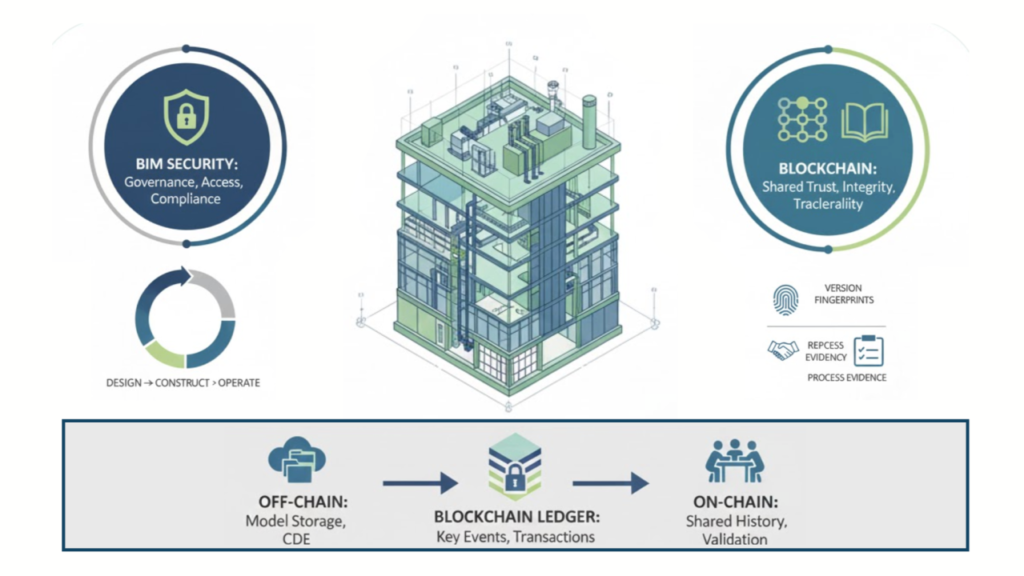
As BIM becomes a shared foundation for design, construction, and operations, security concerns extend well beyond system access or file protection. In practice, BIM security is a governance problem shaped by multi-party collaboration, fragmented responsibility, and long project lifecycles. Most BIM security strategies today rely on a combination of broadly accepted controls, including: Governance and ownership: defining model authority, responsibilities, and decision rights Access control: role-based permissions, least-privilege principles, and offboarding processes Operational discipline: controlled sharing, export approval, and version management Legal and compliance alignment: contractual clarity, auditability, and record retention Third-party and platform risk: external collaborators, cloud services, and AI-enabled tools Data interoperability risk: model exchanges, metadata leakage, and loss of embedded controls These measures remain essential and form the baseline for any BIM security program. However, they tend to operate within individual systems or organizational boundaries. When BIM workflows span multiple firms with uneven authority and trust, gaps often emerge that governance alone struggles to close. Introduce Blockchain: integrity, traceability, and shared trust Blockchain enters the BIM security discussion through its ability to establish shared, tamper-resistant records across organizational boundaries. Its value lies in creating a durable, collectively maintained record of key actions tied to BIM models. In practice, blockchain is used to register: Model version fingerprints that uniquely reference a specific state Responsibility attribution for submissions, approvals, and releases Process evidence showing that agreed workflows were followed Because these records are distributed across participating stakeholders, no single party controls the historical narrative. This reduces reliance on centralized logs and strengthens confidence when questions arise later, particularly in audits, claims, or long-running projects. Recent work published in Scientific Reports proposes a BIM–blockchain integration framework that uses 5D BIM together with blockchain and smart contracts to support automated contract payments, treating the distributed ledger as a coordination and verification layer alongside existing BIM platforms and reinforcing traceability and accountability across project stakeholders. A Framework for Smart Construction Contracts Using BIM and Blockchain (http://rdcu.be/eXFU1) Integration with existing BIM platforms and workflows Most blockchain-enabled BIM approaches are designed to fit into existing environments rather than reshape them. Model authoring, coordination, and access control continue to take place within established Common Data Environments. Blockchain is introduced at specific decision points: Model storage remains off-chain within controlled repositories Key events such as submissions or approvals generate ledger entries Participating parties validate and retain a shared transaction history Verification remains possible long after files have moved or changed hands This separation keeps operational workflows intact while adding a shared reference layer that spans organizational boundaries. Permissioned networks are typically used to align participation with contractual roles and confidentiality expectations. From a governance perspective, this approach strengthens accountability without increasing exposure of sensitive design information. Blockchain nodes. Image courtesy of Brickschain. Security boundaries of blockchain in BIM workflows Blockchain contributes to BIM security when applied with a clear and limited scope. It is most effective in reinforcing trust in collaborative processes, particularly where long timelines and multiple stakeholders make accountability difficult to maintain. Several boundaries remain important: Selective recording: only essential metadata and fingerprints belong on the ledger External controls: access management and export discipline remain critical off chain Process dependency: recorded actions reflect human and organizational decisions When positioned this way, blockchain complements established BIM security practices by addressing a specific structural gap: maintaining a shared, reliable record of responsibility over time. Its value comes from strengthening confidence in collaboration, rather than attempting to replace existing platforms or governance models. Interested in our practice? Let’s connect and discuss your project! Contact us: genx@genxdt.com; 1(201)-500-7534

Blockchain in BIM Security: A Trust Layer for Multi-Party Collaboration Read More »

The Critical Role of Shop Drawings in Modular Projects

In modular construction, shop drawings act as the central information backbone of the entire project. Unlike traditional construction, where many issues can be resolved during installation, modular systems rely on factory-level precision. Every line, note, and dimension in a drawing directly influences how a module is fabricated and how it fits within the overall structure. This makes shop drawings a foundational communication tool across all disciplines. Why Accuracy Matters More in Modular Projects Modular fabrication occurs in controlled production environments where tolerances are tight and workflows depend on upfront clarity. Because modules leave the factory largely complete, late-stage corrections are far more disruptive than in conventional projects. This is why production teams depend on well-organized and unambiguous shop drawings to prevent delays, rework, and misalignment. Correct Information – Correct Scale – Correct Drawing Drawing organization requires early planning. Each drawing must be intentional: Which scale communicates the required detail? Which elements should be included, or omitted, to avoid information overload? How will the complete set maintain consistency across hundreds of modules? Over-detailing can slow fabrication, while under-detailing can cause costly errors. Clear drawing standards established at the start of the project ensure all stakeholders interpret data consistently. Module Identification and Module Type Diagrams Among all drawing types, module identification drawings are essential. They define each module’s: number name type position within the building Even if modules look identical architecturally, they may differ in structure, MEP routing, or production sequencing. If these distinctions are not clarified early, the production phase becomes vulnerable to misfabrication. Typical and Non-Typical Modules A proven strategy is separating modules into typical and non-typical categories. Typical modules can be documented once with detailed enlarged drawings, while non-typical modules require their own dedicated sheets. This approach streamlines coordination, accelerates reviews, and helps production teams focus on the modules that need special attention. In modular projects, shop drawings are more than technical documents: they are the operational language that links design intent with manufacturable detail. When drawing organization, clarity, and module identity are managed effectively, production runs smoothly, installation is predictable, and project outcomes become measurable and consistent. Interested in our practice? Let’s connect and share us more about your project! Contact us: genx@genxdt.com; 1(201)-500-7534

The Critical Role of Shop Drawings in Modular Projects Read More »

Trade Coordination: Managing a Complex, Feedback-Driven Workflow

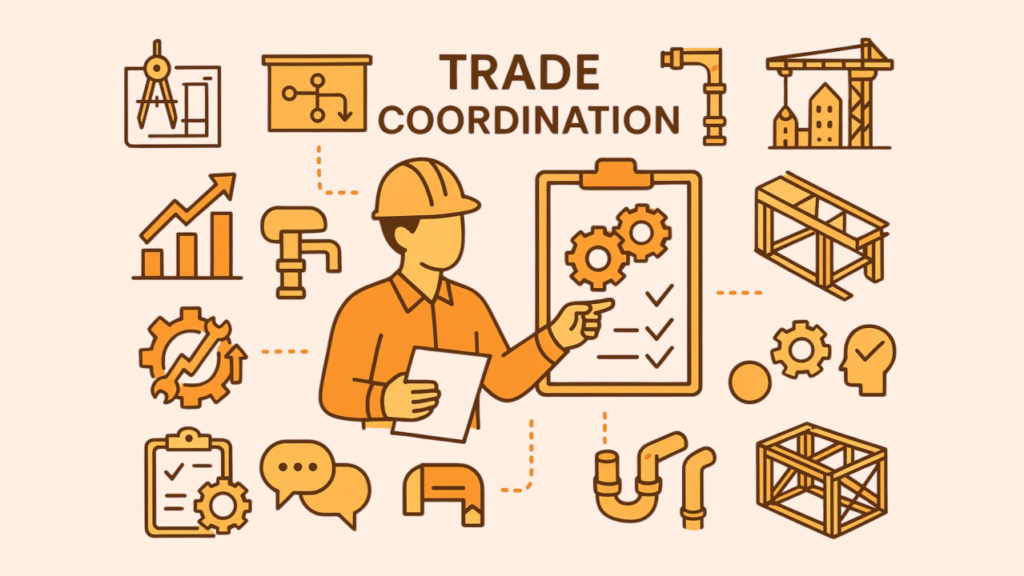
In modular projects, the production process depends on a network of constant coordination. From the first design sketch to the final stage of assembly, every phase feeds information to the next while also being reshaped by updates from the previous one. This chain, running from concept design to on-site assembly, works through ongoing feedback loops. Shifting Priorities Across Trades Different trades, such as structural systems, MEP, façades, architectural, and fabrication teams, take the lead at different stages of the process. These priorities change from project to project, depending on the production sequence. Therefore, coordination involves not only model integration but also the ability to bring the appropriate discipline to the forefront at the appropriate time. Early Design Integration In managing a complex production process, coordination is most effective during the earliest design phase. Involving production and assembly teams in the concept design process early on ensures that production constraints and assembly logic shape design decisions. This way, the feedback loop begins at the design stage; rework rates decrease, material waste is prevented, and production efficiency increases. The “Design for Manufacture and Assembly (DfMA)” approach is one of the most concrete reflections of this early integration. Information Flow and Digital Continuity Managing complexity in modular construction relies on maintaining a seamless flow of information across all project stages. For design, fabrication, and site teams to work in sync, digital continuity must be preserved throughout the workflow. Model-based coordination and centralized data environments, often structured around a single source of truth, ensure that every change, whether initiated from design, production, or the field, is captured and redistributed across all disciplines in real time. This interoperability minimizes data loss, reduces miscommunication, and keeps the digital model aligned with physical progress. As project complexity grows, maintaining data integrity becomes not just a technical task but a key factor in sustaining trust, accountability, and efficiency among all project participants. Collaboration Through Feedback and Technology In a production-focused approach, input from the factory and the field is essential. Feedback directly shapes both shop drawings and production plans, helping teams not only avoid errors but also improve design for manufacturing. Digital tools make this possible. Model-based coordination, version tracking, and production planning help everyone work from the same information. This creates a clear communication flow between design, production, and assembly. Ultimately, trade coordination is the invisible backbone of modular construction. The optimization achieved throughout the process enhances not only design quality but also production efficiency and project speed. Therefore, coordination is not about planning but managing continuous interaction and feedback. Interested in our practice? Let’s connect and share us more about your project! Contact us: genx@genxdt.com; 1(201)-500-7534

Trade Coordination: Managing a Complex, Feedback-Driven Workflow Read More »

The Hidden Complexity of Modular Fabrication

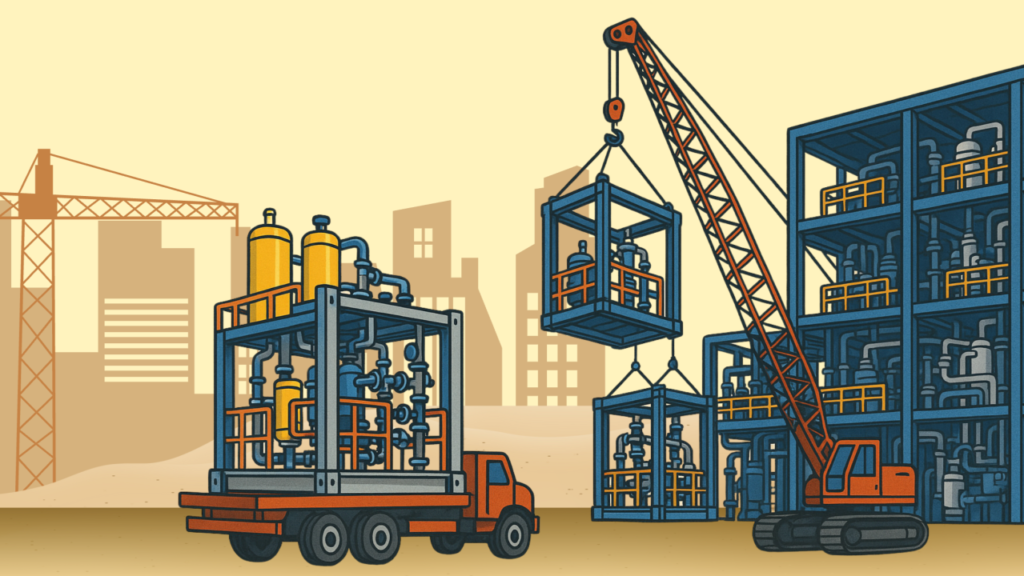
The Hidden Complexity of Modular Fabrication Having worked on multiple modular projects, we’ve experienced firsthand the unique challenges and opportunities that come with this approach. In this series, we’ll walk you through each stage of the process, from early design coordination to shop drawings and on-site assembly, sharing lessons learned, practical insights, and best practices that help transform modular designs into efficient, high-quality builds. Modular Fabrication: More Dynamic Than It Seems Modular fabrication is often seen as a highly standardized process, but in reality, it requires one of the most dynamic coordination efforts in construction. Behind each “identical” module lies a complex sequence of trades, each with its own priorities, dependencies, and fabrication logic. From structural steel to MEP systems to façades, every trade contributes at different stages of production. Coordinating these disciplines is not just about combining models; it’s about understanding when and how each trade should take the lead. The sequence may vary from project to project; for instance, structural elements are often coordinated first, while façade systems typically follow in later stages. Establishing and maintaining this sequence according to fabrication priorities ensures smoother assembly and minimizes rework. Parallel Coordination and Documentation Design coordination must progress in parallel with fabrication documentation. Every revision made in the 3D coordination model should be mirrored and validated through updated, frozen shop drawing sets. Relying solely on digital models without verified documentation can lead to inconsistencies once production begins. In the end, all digital deliverables, including 3D models, trade shop drawings, and design documents, must align with what is actually being fabricated. Ultimately, successful modular fabrication is not just about repetition. It’s about precision, timing, and coordination across trades. A well-sequenced and well-documented process allows DFMA teams to respond quickly to revisions, maintain quality, and deliver true efficiency from design to manufacturing. Interested in our practice? Let’s connect and share us more about your project! Contact us: genx@genxdt.com; 1(201)-500-7534

The Hidden Complexity of Modular Fabrication Read More »

CVU 2025 | A Leadership Conversation on Smart Building

“What comes to mind when you hear the term smart building?” Is it advanced technology, automated systems, or perhaps spaces that seem to “think” for themselves? In truth, the idea goes far beyond gadgets or automation. A smart building weaves together systems, sensors, and data analytics to create spaces that perform better, feel better, and last longer. But as the push for intelligent and connected environments grows, the results don’t always match the promise. Misaligned goals, fragmented design intent, and weak coordination still cause systems to underperform, reminding us that while technology moves fast, planning and integration often fall behind. These challenges are exactly what industry leaders set out to address. During the Council on Vertical Urbanism (CVU) 2025 International Conference in Toronto, our founder and CEO, Ilkay Can-Standard, led the workshop “Design/Build Smarter: Systems & Constructability,” joined by Andrew Altamirano, P.E., Carmine D’Alessandro, Ayse P., and other industry leaders to share their approaches. Integration Defines Intelligence A truly smart building is defined not by how many devices it contains, but by how well its systems communicate and evolve together. As highlighted in the CTBUH discussion, a smart building, as framed in this session, is not only a stack of high-tech systems and devices. Instead, it can be viewed as a product that is designed, built, and operated to follow these three main principles: Sustainability: How to increase a building’s useful life while minimizing its waste and adverse environmental impacts? Adaptability: How to design resilient buildings that retain their social and economic value through changes in social, cultural, economic, and environmental circumstances? Technological Capability: How to make sure that buildings allow its users to benefit from the highest level of technology available? When these three pillars are aligned, teams can act on day one with shared understanding and measurable outcomes. Integration becomes the structure that keeps the project moving as one system. Owners Need Structured Outcomes Example: 343 Madison Avenue From energy performance to space utilization, owners increasingly seek data-driven insights to inform long-term operations. With technologies like IoT and building management systems, buildings can now communicate across systems, creating environments that are healthier, more comfortable, and more efficient for their users. In projects like 343 Madison in New York, discussed during the CTBUH 2025 workshop, these ideas were translated into real practice. By defining sustainability targets and data structures early, the team connected design logic, operational goals, and performance tracking within one coordinated model. As a result, facility managers could monitor energy use and comfort levels from the first day of operation, turning the concept of “smart” into measurable, everyday outcomes. Bridging the Gap: Where Does GENx Play a Role? As discussed in the CTBUH session, clarity is what keeps construction teams efficient. When models are organized under common standards and ownership is clearly defined, trades can plan installations with confidence, procurement moves earlier, and on-site work stays predictable. Clear data paths transform digital models into reliable instructions, align teams toward common goals, and turn complexity into coordinated progress across the entire project lifecycle. So how can this idea work in real projects? That’s exactly where we create value. At GENX Design and Technology, our goal is to make the framework usable from day one. We focus on trade-ready VDC services that bring key decisions earlier, reduce uncertainty at bid, and keep information consistent from concept to handover. Our role is practical and rooted in delivery: we set clear rules, model what trades need, and turn coordinated designs into constructible, data-rich outcomes. The result is fewer surprises, faster approvals, and a schedule that moves forward with confidence. Interested in our practice? Let’s connect and start a conversation today!

CVU 2025 | A Leadership Conversation on Smart Building Read More »

Still Stuck in 2D CAD? How 5D Modeling Can Save You Millions

Beyond Lines on a Screen: What 5D Really Means For decades, 2D CAD has been the standard for documenting designs. It is precise and familiar, but in today’s complex projects, it often leaves critical gaps. Drawings capture geometry, yet they don’t show how a change in design might ripple through schedules and budgets. 5D Building Information Modeling (BIM) addresses this by expanding on the 3D model with two additional dimensions: time and cost. In a 5D environment, each element in the model carries information about when it will be built and how much it will cost. A single design adjustment, such as modifying a wall’s dimensions, can automatically update quantities, installation timelines, and budget forecasts. The result is a model that behaves more like a living project database than a static set of drawings. Why Staying in 2D Can Cost More Than You Realize In a 2D workflow, design files, schedules, and cost data usually live in separate systems. This separation slows decision-making and makes it harder to understand the real impact of a change until the consequences have already reached the site. By then, adjustments are more disruptive and more expensive. With 5D modeling, the connection between design, time, and cost is visible from the beginning. Project teams can explore “what if” scenarios, test the effects of design options on delivery timelines, and see how different material choices influence both budget and sequencing. This foresight allows adjustments to be made when they are least costly and most effective, reducing the likelihood of delays or unplanned expenses. Turning Information into Better Decisions The strength of 5D modeling lies not only in the richness of the data, but in how it supports collaboration. A single integrated model provides a consistent reference point for owners, designers, and contractors, making it easier to align expectations and reduce miscommunication. Cost and schedule impacts are no longer abstract figures in a report; they are tied directly to visible design elements in the model. When stakeholders can see the implications of a choice in both spatial and financial terms, discussions become more productive, and approvals move more quickly. This transparency helps maintain trust and keeps projects moving forward with fewer surprises. With cost and time linked directly to design elements, teams can: Forecast accurately and adjust early when conditions change Prevent scope creep before it impacts the bottom line Coordinate across disciplines using a shared, up-to-date model Reduce approval cycles by presenting clear, data-backed scenarios The result is not just better drawings, it’s a faster, leaner, and more predictable project. How GenX Delivers the Value of 5D Introducing 5D BIM to a project is not just a matter of installing new software. It requires a deliberate process to integrate geometry, time, and cost data, and to keep that integration consistent throughout the project lifecycle. At GenX, we build this foundation from the earliest stages of design. Our approach combines: Structured data standards that keep cost and schedule information accurate throughout the project Cross-team coordination that brings owners, designers, and contractors into the same decision-making process Ongoing model management to ensure forecasts remain reliable as the project evolves By uniting technical precision with disciplined coordination, we help teams move from reactive problem-solving to confident, proactive delivery. A More Informed Way Forward The move from 2D CAD to 5D BIM is not about abandoning familiar tools, but about enhancing them with a layer of intelligence that makes projects easier to plan, track, and deliver. By linking design, schedule, and cost in one place, 5D modeling provides the clarity needed to make timely, informed decisions. For projects where predictability matters as much as precision, this approach can mean the difference between managing change and being managed by it.

Still Stuck in 2D CAD? How 5D Modeling Can Save You Millions Read More »

Smart Building – What Owners, Designers, and Builders Need to Know and Ask For?

A smart building is broadly understood as one that uses interconnected systems, sensors, and data analytics to optimize performance, enhance occupant experience, and support long-term operational efficiency. As demand for more intelligent, efficient, and connected buildings increases, the term “smart building” has become nearly ubiquitous across project briefs. Yet despite this growing expectation, the path to realizing smart outcomes remains inconsistent. Misaligned goals, fragmented design intent, and unclear coordination workflows often lead to underperforming systems or siloed technologies that fail to deliver on their potential. While technology adoption has advanced rapidly, the surrounding processes like planning, modeling, data management, and integration frequently lag behind. To bridge the gap between aspiration and outcome, smart buildings must be treated not as technology packages but as systems that require early alignment, structured information, and cross-disciplinary coordination from the outset. 1. Integration Defines Intelligence A truly smart building is not defined by the quantity of devices it contains, but by the quality of integration between its systems and the ability to respond to future needs. When smart features such as lighting, HVAC, access control, and sensors are specified in isolation or added late in the project, the result is often redundancy, inefficiency, or missed functionality. Early coordination is crucial, leveraging a shared spatial and data environment to embed performance logic, physical layout, and system intent directly into the model structure. Successful integration relies on standardized modeling practices, clearly defined data exchanges, and shared digital frameworks that guide disciplines toward common outcomes. 2. Owners Need Structured Outcomes, Not Just Systems From energy performance to space utilization, owners increasingly seek data-driven insights to inform long-term operations. However, many smart systems are delivered without usable structure, with disconnected devices, inconsistent naming, or missing metadata. Without a cohesive digital handover strategy, facilities teams often inherit complexity rather than clarity. Structured BIM environments, consistent parameter mapping, and documented data expectations are critical to ensuring that operational value can be extracted from day one. Clear information delivery protocols, rather than more devices, are what ultimately support smarter ownership. 3. Design Tools Must Serve Coordinated Performance Designers today use advanced tools for simulation, parametric modeling, and environmental analysis. Yet without integration across disciplines, these tools may fail to translate into system-wide intelligence. Smart building design is not just about isolated performance metrics. It requires the alignment of spatial logic, system behavior, and constructability, which is reflected in a coordinated digital environment that can be understood and used across trades. Embedding performance requirements into shared models, along with clearly defined digital standards, enables smart intent to remain intact from concept to construction. 4. Builders Rely on Information Clarity, Not Volume For construction teams, smart building projects often introduce added complexity. System routing, commissioning sequences, and device coordination must all be tightly managed. Yet project documentation can remain fragmented, with critical information spread across disparate formats or incomplete models. What’s needed is not more files, but greater information clarity: scope-aligned model views, well-structured metadata, and defined logic pathways that connect systems to constructible workflows. Effective delivery relies on more than technical compliance; it requires accessible digital content that accurately represents system interactions and timing. 5. Cross-Disciplinary Alignment Is the True Enabler While smart buildings involve advanced technologies, their success hinges on something more fundamental: alignment. Owners think in terms of outcomes. Designers think in models. Contractors think in construction logic. Without a common coordination structure, misinterpretation is inevitable, and value is lost. Centralizing standards, model protocols, and communication workflows enables consistent translation between intent and delivery. When this structure is actively maintained, it reduces scope gaps, accelerates approvals, and supports integrated decision-making across the project lifecycle. Smart buildings are not solely defined by the technologies they contain. Their value lies in how effectively those systems are integrated, and in the building’s capacity to respond to evolving operational needs. Consistency in standards, coordination in delivery, and structure in information management are the true foundations of building intelligence. As digital complexity grows, the ability to align systems, people, and models early will remain the most reliable driver of smart outcomes.

Smart Building – What Owners, Designers, and Builders Need to Know and Ask For? Read More »

No Standards, No Problem: Setting Company BIM Standards from Scratch

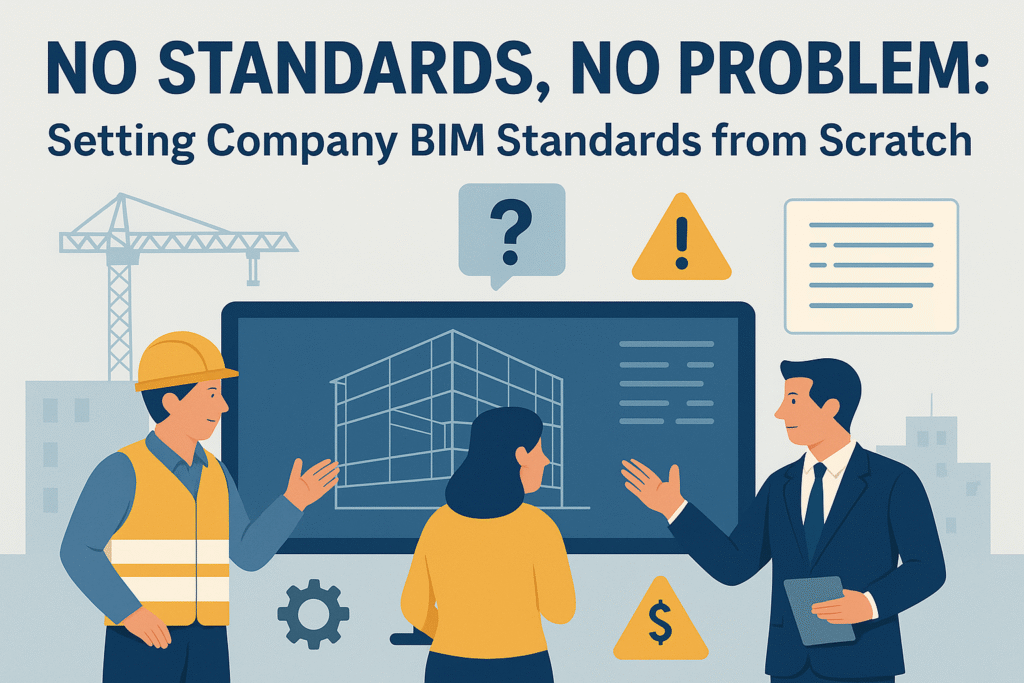
No Standards, No Problem: Setting Company BIM Standards from Scratch   “Everyone’s using BIM, but no one seems to agree on how.” That’s the quiet frustration we hear again and again from project teams, especially those working across contractors, subs, and consultants. BIM is meant to bring clarity and coordination. But without a unified set of standards, it can quickly spiral into confusion: mismatched models, inconsistent naming, incomplete geometry, and hours lost trying to decipher someone else’s logic. For general contractors and project owners, managing multiple stakeholders presents not just an annoyance, but a significant risk. So why is it so hard to standardize BIM? And what can be done when you’re starting from scratch? The Pain Points Behind the Model If you’re overseeing a project and find yourself asking… “Why doesn’t this model match the LOD we asked for?” “Who decided this naming convention?” “Why is it taking so long to get coordinated drawings?” …you’re not alone. Many firms dive into BIM without a clear roadmap. Some rely on inherited templates. Others borrow standards from past projects that were never designed for collaboration. In large, fast-moving builds, this lack of structure quickly multiplies: Inconsistent modeling between trades Delays in approvals due to unclear deliverables Rework from incompatible formats or broken links Lost trust between stakeholders who can’t “see” each other’s intent In essence, it’s not just a file problem. It’s a communication problem. Why Setting Standards Feels So Hard For many project teams, establishing BIM standards from zero feels overwhelming. You might be wondering: Do we need a BEP (BIM Execution Plan) or just a few templates? Is there an industry standard we can copy? What if our consultants or subs all work differently? It’s tempting to think of BIM as software-driven. But the truth is, BIM success is workflow-driven. And workflows don’t just happen; they’re designed. That’s where a tailored, project-first approach makes a difference. How GenX Helps You Build the Standard That Works At GenX, we understand that in large, multi-stakeholder projects, BIM isn’t just a modeling tool, it’s a coordination language. Without clear standards and aligned expectations, even the best tools fall apart under pressure. That’s why we go beyond model production. We act as an integration partner, bridging the gaps between owners, contractors, consultants, and subs to ensure alignment from day one. Our role often sits between design and execution, helping clients: Define and implement BIM standards tailored to the project’s scale, systems, and delivery strategy. Foster cross-team coordination by bridging technical disciplines and synchronizing workflows across different time zones and organizations. Proactively surface design or scope risks through early clash detection, model auditing, and structured information flow. Ensure model clarity, contractual alignment, and measurable deliverables to control scope creep and reduce costly change orders. This integrated approach streamlines coordination, upholds project quality, and mitigates risks associated with complex construction schedules. This is particularly beneficial for infrastructure and public-sector projects, where reliability and adherence to regulations are paramount. From Scratch to Scalable We’ve helped clients go from disorganized file shares to clean, collaborative BIM environments in a matter of weeks. The results? Fewer RFIs Faster reviews Better trust between trades And most importantly, a smoother path to delivery that everyone understands, aligns on, and can confidently move forward with. Starting from scratch doesn’t have to mean starting in chaos. With the right structure and the right partner, you can turn confusion into coordination. Have a project that needs a clean slate? Let’s talk about building your BIM standards, from the ground up.

No Standards, No Problem: Setting Company BIM Standards from Scratch Read More »

What is the difference between a manufactured home and a modular home?

View All Blogs What is the Difference Between a Manufactured Home and a Modular Home? What is the Difference Between a Manufactured Home and a Modular Home? When it comes to finding the ideal home, there are various choices on the market. Two well-liked options are manufactured and modular homes; both provide unique advantages and customization opportunities over traditional stick-built homes. This comprehensive guide will detail these two housing types by exploring their differences, customization possibilities, affordability, cost factors, building codes, regulations, benefits, and drawbacks. What Is a Manufactured Home? A manufactured home, also known as a mobile or trailer home, is a prefabricated house built in a factory and transported directly to its desired location. Built on permanent chassis frames designed to facilitate mobility if necessary, these houses come in all sizes and styles. They range from single-section units to larger multi-section dwellings. They are intended to comply with federal building codes set by the U.S. Department of Housing and Urban Development (HUD). What Is a Modular Home? Modular homes are another form of residence built in factories, but unlike manufactured homes, they are constructed as individual modules to be transported and assembled on-site. Once completed, they resemble stick-built houses and must meet local building codes. For additional details, check out this National Association of Home Builders (NAHB) guide. The Difference between Manufactured Homes and Modular Homes a) Construction and Transport Manufactured homes are built on permanent chassis designed for transportability and assembled as one unit in the factory before being transported directly to their desired locations. Modular homes differ by being composed of individual modules produced in separate factories that can be transported separately before finally being assembled on-site to form one cohesive house. b) Building Codes Manufactured homes must adhere to federal building codes established by the U.S. Department of Housing and Urban Development (HUD), ensuring specific safety and quality standards are met. On the other hand, modular homes are subject to local building codes similar to traditional stick-built homes in that they must comply with the requirements and regulations set by their installation area. Visit the International Code Council (ICC) for more details on building codes. c) Design Flexibility Modular homes offer greater design versatility than manufactured homes, as they’re assembled on-site. Homeowners have more customization options and can tailor the design according to their preferences by choosing floor plans, finishes, and fixtures that suit their lifestyles and needs. Manufactured homes may offer some degree of design freedom due to being prefabricated units constructed at a factory. d) Mobility Manufactured homes are often designed for easy mobility and can be transported between locations if necessary. Modular homes typically serve as permanent structures and do not require relocation. Customization Options in Manufactured Homes and Modular Homes Both manufactured and modular homes offer numerous customization options, allowing residents to tailor their living space exactly how they wish. Examples of such customization features are: a) Floor Plans Homeowners can choose from a variety of floor plans designed to suit their lifestyle and space requirements. Options can include open-concept layouts with multiple bedrooms and numerous amenities. Check out some example floor plans at MHVillage. b) Finishes and Fixtures Homeowners have many choices when selecting finishes and fixtures that reflect their design aesthetic, such as cabinets, countertops, flooring materials, and lighting fixtures. For ideas and inspiration, visit Houzz. c) Exterior Features Manufactured and modular homes can also feature customized exterior elements, including siding materials, roofing options, and window styles. Learn more about exterior options at Better Homes & Gardens. Construction Quality and Durability Manufactured and modular homes are constructed in controlled factory environments, offering greater precision and quality control than traditional on-site construction. Materials used are often similar to those found in stick-built houses, ensuring maximum durability and longevity. Reputable manufacturers and builders must be chosen to achieve optimal construction standards. Learn more from the HUD’s Manufactured Housing Standards. Affordability and Cost One of the most significant advantages of manufactured and modular homes is their affordability compared to traditional houses. Their controlled factory construction environment allows for cost savings through economies of scale, reduced material waste, streamlined processes, and shorter construction times, resulting in decreased labor costs. However, customization, location, and site preparation can still affect final costs. For more information on costs, visit the MHVillage Cost Guide. Building Codes and Regulations Manufactured homes must comply with federal building codes, while modular homes must adhere to local building codes. Both construction styles must pass inspections at various stages to ensure safety and quality standards compliance. Working with reliable manufacturers and builders who adhere to these principles and regulations is vital to creating compliant homes that stand the test of time. For more details on building codes, visit the International Code Council (ICC). The Benefits and Drawbacks of Manufactured and Modular Homes Before purchasing a manufactured or modular home, it is crucial to consider their potential advantages and drawbacks. Benefits Affordability: Manufactured and modular homes are typically priced lower than traditional stick-built houses, making them an appealing solution for those on a tight budget. Customization: Homeowners can select different floor plans, finishes, fixtures, and exterior features to craft a home that reflects their tastes and preferences. Controlled Construction: These homes are constructed within a factory environment, ensuring higher construction quality and precision with standardized processes and stringent quality control measures. Time Efficiency: Constructing a manufactured or modular home takes considerably less time than traditional houses. Most of the construction process occurs within factories, reducing delays and disruptions. Energy Efficiency: Modern manufactured and modular homes are often built to be energy-efficient, featuring insulation upgrades, energy-saving appliances, and HVAC systems that help lower utility costs and reduce environmental impacts. Modern Amenities: Manufactured and modular homes can include modern amenities and technologies such as smart home features, energy-efficient lighting solutions, and advanced security systems. Flexibility: Manufactured and modular homes provide greater flexibility in choosing their desired location, from private lots to communities explicitly designed for these homes. Drawbacks Limited Resale Value: Manufactured homes tend

What is the difference between a manufactured home and a modular home? Read More »

Scroll to Top