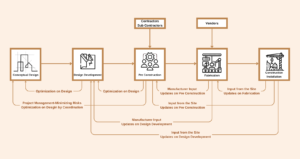
In modular projects, the production process depends on a network of constant coordination. From the first design sketch to the final stage of assembly, every phase feeds information to the next while also being reshaped by updates from the previous one. This chain, running from concept design to on-site assembly, works through ongoing feedback loops.
Shifting Priorities Across Trades
Different trades, such as structural systems, MEP, façades, architectural, and fabrication teams, take the lead at different stages of the process. These priorities change from project to project, depending on the production sequence. Therefore, coordination involves not only model integration but also the ability to bring the appropriate discipline to the forefront at the appropriate time.
Early Design Integration
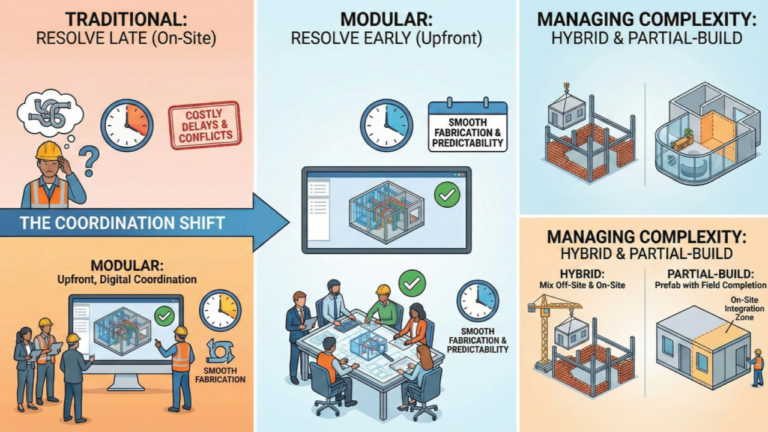
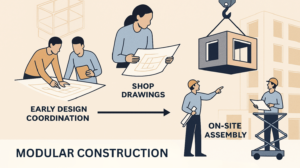
In managing a complex production process, coordination is most effective during the earliest design phase. Involving production and assembly teams in the concept design process early on ensures that production constraints and assembly logic shape design decisions.
This way, the feedback loop begins at the design stage; rework rates decrease, material waste is prevented, and production efficiency increases. The “Design for Manufacture and Assembly (DfMA)” approach is one of the most concrete reflections of this early integration.
Information Flow and Digital Continuity
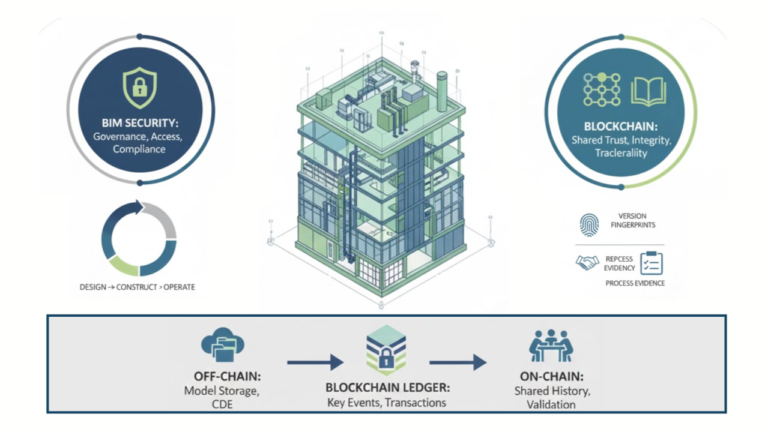
Managing complexity in modular construction relies on maintaining a seamless flow of information across all project stages. For design, fabrication, and site teams to work in sync, digital continuity must be preserved throughout the workflow. Model-based coordination and centralized data environments, often structured around a single source of truth, ensure that every change, whether initiated from design, production, or the field, is captured and redistributed across all disciplines in real time.
This interoperability minimizes data loss, reduces miscommunication, and keeps the digital model aligned with physical progress. As project complexity grows, maintaining data integrity becomes not just a technical task but a key factor in sustaining trust, accountability, and efficiency among all project participants.
Collaboration Through Feedback and Technology
In a production-focused approach, input from the factory and the field is essential. Feedback directly shapes both shop drawings and production plans, helping teams not only avoid errors but also improve design for manufacturing.
Digital tools make this possible. Model-based coordination, version tracking, and production planning help everyone work from the same information. This creates a clear communication flow between design, production, and assembly.
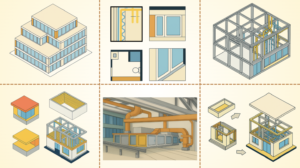
Ultimately, trade coordination is the invisible backbone of modular construction. The optimization achieved throughout the process enhances not only design quality but also production efficiency and project speed. Therefore, coordination is not about planning but managing continuous interaction and feedback.
Interested in our practice? Let’s connect and share us more about your project!
Contact us: genx@genxdt.com; 1(201)-500-7534